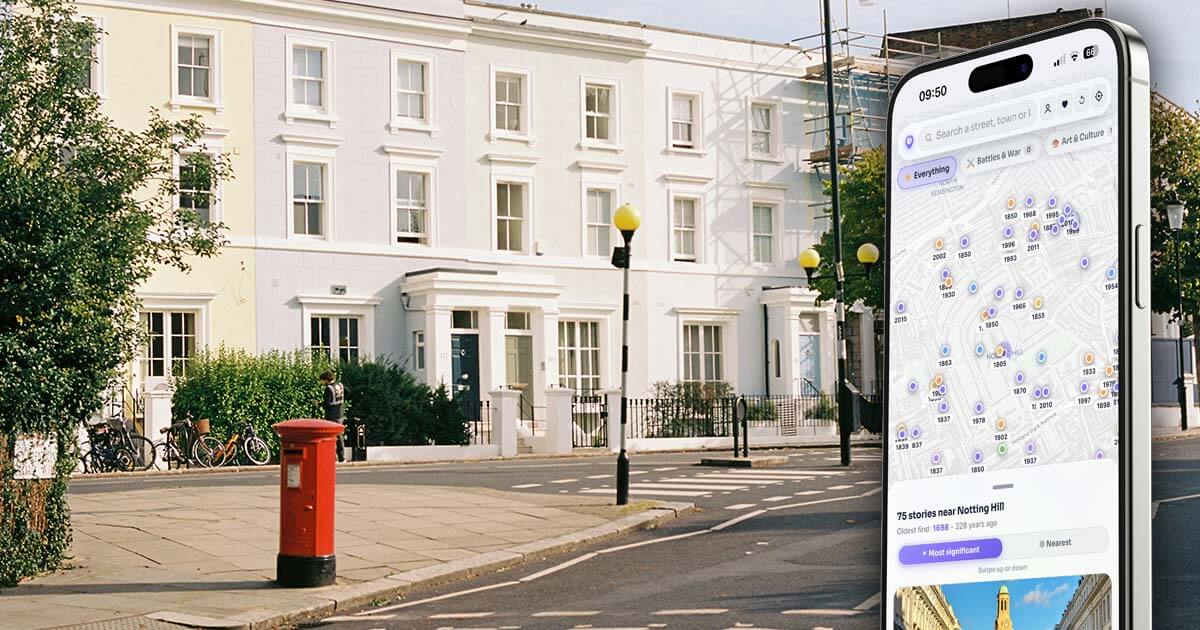
Notting Hill has a reputation that can feel almost too polished: pastel terraces, antique stalls, film backdrops, and a sense that the neighbourhood was always destined to be charming. Walk it slowly, though, and a different Notting Hill comes into focus - one shaped by land ownership, speculative building, waves of migration, crowded housing, creative energy, and the long argument over who a neighbourhood is really for.
This is a local history walk, not a checklist. You can do it in a couple of hours, or stretch it across an afternoon with cafe stops. The goal is simple: read Notting Hill by location. Pay attention to boundaries, street patterns, and what remains from older uses.
Start with the street that tells the truth: Portobello Road
If you only know one place-name here, it is Portobello Road. On market days, the street performs. Off-peak, it reveals the bones of a working high street that has been repurposed many times.
Portobello’s story is a good reminder that "famous" does not mean "simple". The market grew from ordinary trade: food, household goods, second-hand clothing, and the steady commerce of a dense neighbourhood. Over time, antiques and collectables built a global reputation, but the street still contains fragments of earlier Notting Hill - the local rhythms that existed long before visitors arrived with cameras.
To read Portobello historically, look for:
- Changes in shopfront width that hint at older plots and later mergers.
- Back lanes and mews that once supported stables, deliveries, and small workshops.
- Corners where the street widens slightly, suggesting former trading pinch points.
If you want a quick way to pull stories out of the street itself, open Portobello Road in LocoPast and pan north and south. Even a short scan shows how densely layered the area is when you stop treating it as a single attraction.
The power of a square: garden estates and controlled beauty
Notting Hill’s garden squares are not just pretty. They are a physical record of how London expanded: planned streets, controlled access, and an urban ideal built around private green space.
Many squares were designed to create an atmosphere of calm and status. The gardens at their centres were often fenced and managed, and the surrounding terraces were built to a pattern that signalled taste. This is not unique to Notting Hill, but it is unusually visible here because the terraces and crescents still read clearly as a system.
When you stand on the edge of a square, you can almost feel the logic:
- The garden is a centrepiece, a selling point, a controlled commons.
- The buildings face inward, signalling belonging and order.
- The street layout encourages strolling, not only movement.
That design history matters because it created sharp contrasts. Just a few streets away from a well-kept square, you can find housing that was once crowded, subdivided, and under-maintained. Notting Hill contains both stories at once.
A neighbourhood of thresholds: where Notting Hill meets the rest of London
Notting Hill is often treated as a self-contained brand, but historically it is a set of thresholds: between the West End and the western suburbs, between wealth and precariousness, between inward-facing squares and outward-facing streets of trade.
You can see those thresholds in the built environment:
- A sudden shift from grand facades to plainer terraces.
- A main road that acts like a seam between micro-neighbourhoods.
- A run of buildings that looks "newer" because it was rebuilt after clearance or redevelopment.
When you notice those seams, Notting Hill stops being a postcard and starts being a city district - shaped by policy, property, and pressure.
The human history: migration, community, and the making of culture
No honest Notting Hill history can avoid its modern cultural story: the post-war period brought new residents and new community life, including people who arrived from the Caribbean and elsewhere. With them came food, music, faith communities, family networks, and a kind of London energy that is easy to romanticise but was often forged under strain.
Notting Hill became a site of conflict and resilience. Housing conditions could be brutal. Overcrowding and exploitative renting were not abstract problems - they were experienced room by room, stairwell by stairwell. Community organising and mutual support grew in response, as did a local politics that was intensely street-level.
Carnival culture - with its sound systems, costumes, procession routes, and collective presence - is a location story as much as anything else. It is about streets and junctions and the meaning of public space. When you walk Notting Hill today, you are walking through a neighbourhood where public celebration has been argued over, defended, and reimagined.
Listen to the architecture: what gets kept, what gets replaced
Notting Hill’s most photographed buildings can distract from the deeper question: what has been preserved, and why?
Some structures survive because they are beautiful. Others survive because they were adaptable. Others disappear because they were deemed unfit or inconvenient. That survival story is often written into the details:
- A facade that looks older than the windows suggests refacing and modernisation.
- A terrace with uneven rooflines suggests incremental building and later changes.
- A block that breaks the rhythm of the street might mark a redevelopment boundary.
When you walk, try a simple exercise: pick one street and note every place where the building rhythm changes. Those changes are the footprint of decisions - economic, legal, and aesthetic.
A walking route that feels like Notting Hill
Here is a loose route that captures several layers without turning the day into a forced march:
- Begin near Notting Hill Gate and walk towards the quieter streets where the grid softens into squares and crescents.
- Drift into the garden-square belt and notice how the streets are designed for a particular kind of calm.
- Head towards Portobello Road and let the street pull you north or south depending on what catches your eye.
- Step sideways into a mews to feel how service lanes and stables once sat behind the showy frontage.
- Return via a main road and notice how quickly the neighbourhood tone shifts.
You do not need to know the "correct" story at every stop. The point is to let place suggest questions: why here, why this shape, why this boundary, why this density?
How to use LocoPast in Notting Hill (without staring at your phone)
Notting Hill is ideal for location-based exploration because it rewards short moves. The stories are close together, and the neighbourhood has lots of visual cues that connect to narratives.
Try this method:
- Open the map and filter to one topic first, so the pins feel coherent.
- Tap one story, read just enough to know what to look for, then look up.
- Walk to the next pin on the same theme, staying within a few streets.
- Save any story that makes you want to come back, so you build a repeatable route.
If you prefer to start from a single anchor point, search around Notting Hill Gate and scan outward. LocoPast works best when you treat it as a compass for curiosity rather than a tour guide.
Notting Hill’s lesson: charm is usually the surface layer
Notting Hill’s charm is real, but it is not the whole story. The neighbourhood was shaped by plans and property, but also by crowding, activism, cultural invention, and the ongoing question of who gets to belong in a valuable part of a global city.
If you leave with one habit, let it be this: when a street looks picturesque, ask what it used to do, who lived here when it was not fashionable, and what parts of the older neighbourhood are still hiding in plain sight. Notting Hill is not only a film set. It is a place that has been fought over and remade, one street at a time.