The app stores are crowded with "AI tour guides", GPS audio walks, and heritage maps. Many are free to download and then quietly paywalled. Others are genuinely free but limited to one country, one city, or a handful of famous routes. If you want to discover local history on foot in 2026, you need a clear sense of what each tool is actually good at.
This comparison focuses on apps you can use without paying upfront, what their free tiers really include, and which jobs they do well: curated walking tours, historical markers, spontaneous "what is this building?" discovery, and map-first exploration anywhere you stand.
How we compared them
We judged free history apps on five practical criteria:
- True free access - Can you learn something useful without a subscription on day one?
- Location awareness - Does the app respond to where you are, or only to pre-set routes?
- Geographic coverage - Is it strong in the US, Europe, or both?
- Content style - Curated expert tours, community-authored entries, AI narration, or map pins?
- Best use case - First-time tourist route, neighbourhood wander, or deep local research?
No single app wins every category. The useful approach is to match the tool to the walk.
Clio - free historical markers and community walking tours
Clio is a non-profit history platform with a free website and mobile app. It grew out of university and museum collaboration in the United States and now hosts tens of thousands of landmark entries plus more than a thousand walking tours and heritage trails. Entries are authored by historical societies, libraries, museums, and classrooms, which gives the content a documentary feel rather than a marketing one.
Strengths: Completely free to use. Strong for US cities and college towns. Geofencing can notify you when you are near an entry. Walking tours include live maps and directional guidance. Virtual museum-style experiences exist alongside outdoor trails.
Limitations: Coverage is still heavily US-centred, though international entries exist and are growing. Content quality varies by contributing organisation. Recent user feedback also flags occasional stability issues, so it is wise to download key tours before you rely on them mid-walk.
Best for: Travellers and students in North America who want free, place-based entries written by heritage organisations rather than generic AI summaries.
History Near You - GPS alerts for US historic sites
History Near You is built around a simple promise: ping you when you pass history. The free iOS app indexes well over 160,000 historical sites across all fifty US states, saves places you have been near, and offers a "history of the day" feed.
Strengths: Excellent for casual discovery while driving, cycling, or walking familiar routes. The notification model suits people who would never open a guidebook unprompted. Building a personal collection of visited sites is motivating.
Limitations: US-only focus. The experience is closer to a landmark alert system than a deep narrative guide. You get proximity and a write-up, not a curated multi-stop tour with thematic structure.
Best for: US residents who want history to interrupt the commute in a good way.
Rick Steves Audio Europe - free classic walking tours
Rick Steves Audio Europe remains one of the most reliable free options for first-time visitors to major European cities. The app packages self-guided walking and museum tours drawn from Steves' guidebooks, plus travel talk excerpts. Tours cover destinations from London and Edinburgh to Athens and Seville, with downloadable audio and complementary maps so you can listen offline.
Strengths: Genuinely free, well paced, and trustworthy for classic tourist routes. Offline listening avoids roaming surprises. The voice and structure feel like a knowledgeable companion on Westminster Walk or the Royal Mile.
Limitations: Not AI, and not spontaneous. You follow a prepared route through famous sights. It will not explain the unlabelled warehouse two streets off the tour, and it is not designed for your home neighbourhood.
Best for: Budget travellers doing headline European itineraries who want polished audio without paying for a private guide.
VoiceMap - GPS audio tours with a free-and-paid mix
VoiceMap offers self-guided audio tours in hundreds of destinations worldwide. Tours play automatically based on GPS so you can keep your eyes on the street. After download, tours work offline with an offline map. London alone has a large catalogue, including history-focused walks and celebrity-narrated routes.
Strengths: High production values and local storytellers - journalists, historians, novelists, and guides. Excellent for themed walks (Roman walls, historic pubs, alternative city histories). The resume feature is practical when you stop for coffee.
Limitations: Many of the best tours are paid. The free catalogue is real but uneven by city. Treat "free app" as "freemium library", not an unlimited free archive.
Best for: Walkers who want a produced audio narrative for a specific neighbourhood and are willing to buy individual tours when the free pickings run out.
HearHere History - auto-narration where you stand
HearHere History leans into the spontaneous question: open the app and hear a story about the street or neighbourhood you are in. The free tier includes a limited number of narrations per day (five at the time of writing), with premium unlocking unlimited plays, multilingual narration, and structured walking tours.
Strengths: Low friction. Good for curious wanderers who dislike choosing a tour in advance. Follow-up questions and map exploration extend a single stop into a longer session.
Limitations: The free daily cap makes it a sampler rather than an all-day companion unless you upgrade. As with other AI-assisted narration tools, depth and sourcing vary by place; treat it as a prompt for further looking, not a final authority.
Best for: Short exploratory walks where you want one or two stories without planning a full route.
Herodot AI and other photo-to-story tools
Herodot AI represents a growing 2026 category: point your camera at a building and receive a narrated historical context. Similar "visual recognition plus story" features appear in other AI tour products. These tools excel when you are already standing in front of something striking and want immediate context.
Strengths: Spontaneous. Satisfying for landmark-heavy historic centres. Persona options (historian, local guide, family-friendly) help match tone to your group.
Limitations: Mostly reactive. They explain what you photograph more than they plan a coherent walk or connect one stop to the next. Coverage and accuracy are strongest at famous sites and thinner on ordinary streets.
Best for: Travellers who explore by instinct and want on-the-spot context for buildings that catch their eye.
LocoPast - map-first history wherever you are
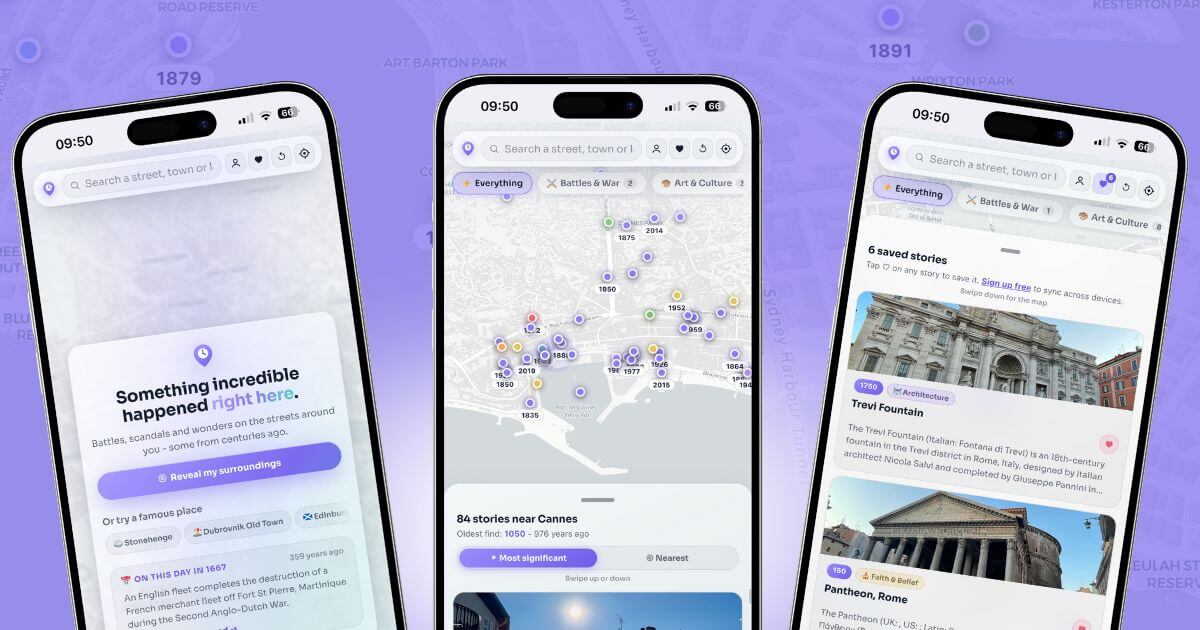
Most of the apps above are either tour players or marker browsers. LocoPast takes a different starting point: history as a map of events and places pinned to coordinates. Instead of committing to a linear audio route, you open the map where you stand and see what is nearby, then walk toward the stories that interest you.
That model suits both holidays and home neighbourhoods. You are not limited to a pre-authored tour of the old town. You can stand on a suburban corner, a harbour wall, or a cathedral close and ask what is around you. Midway through a walk, that flexibility matters more than another polished intro to the same famous square.
Try it on familiar ground first, then on a dense historic core. Open LocoPast in your browser or app, or practise on a layered destination such as Edinburgh Old Town to see how pins fan outward from a well-known anchor.
Best for: People who want location-first discovery - browse, filter by interest, and build their own route from nearby stories rather than following a single scripted path.
Quick comparison table
| App | Free to use? | Strongest region | Style | Best job |
|---|---|---|---|---|
| Clio | Yes (non-profit) | USA | Markers and org-authored tours | Free heritage entries on the ground |
| History Near You | Yes | USA | GPS site alerts | Passive discovery while moving |
| Rick Steves Audio Europe | Yes | Major European cities | Curated audio walks | Classic first-visit routes |
| VoiceMap | Freemium | Global cities | GPS audio tours | Produced neighbourhood narratives |
| HearHere History | Free daily limit | Broad / variable | Auto-narration | Quick "what happened here?" samples |
| Herodot AI | Check current tier | Landmark-heavy sites | Photo-to-story | Spontaneous building context |
| LocoPast | Free to explore on the map | Growing location coverage | Map pins and place stories | Build your own history walk anywhere |
Which should you download?
- First trip to London, Rome, or Edinburgh on a budget: start with Rick Steves; add VoiceMap if you want a second themed walk.
- Road trip or neighbourhood loops in the US: Clio plus History Near You cover authored entries and passive alerts well.
- You hate fixed routes and want to wander: HearHere for a quick sample, Herodot-style tools for buildings you photograph, and LocoPast when you want a full nearby map of stories.
- You are at home and bored of the same high street: skip tourist audio tours entirely. Use a map-first tool and local archive sites; the history is there, just not packaged as a "top ten".
A practical way to use several apps together
The best setup in 2026 is rarely one app. Use Rick Steves or VoiceMap when you want a guided spine through a famous centre. Use Clio or History Near You when markers and alerts matter. Use photo-to-story tools for one-off buildings. Use LocoPast when you want to leave the script and follow density on the map.
Whatever you choose, keep the phone as a companion rather than a screen to stare at. Read or listen, then look up. The point of a local history app is not to replace the street. It is to make the street legible.