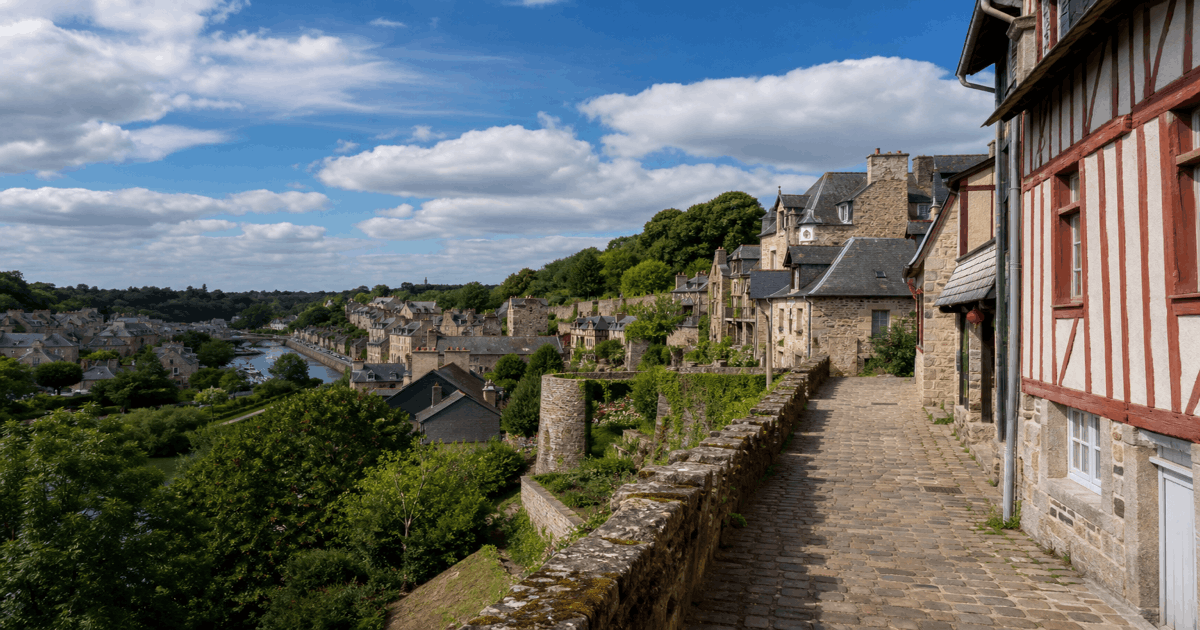
Dinan crowns a hill above the River Rance in eastern Brittany, a fortified town that controlled trade between the coast and the interior. Duke John IV built the castle; merchants filled the streets with timber-framed houses; the port below shipped cloth and wine. This guide follows a single day on foot: castle to ramparts, ramparts to port, port back to the upper town.
Step 1: Château de Dinan
Start at the castle, the highest point of the town and seat of the Dukes of Brittany's local authority. The keep, towers, and walls date largely to the 14th century. Exhibitions cover the Dukes, the Breton independence movement, and daily life in a border fortress.
Inside the complex, the Musée du Château and Tour de Coëtquen display Breton furniture, weapons, and models of the town at different periods. Open LocoPast on the ramparts to uncover stories of sieges and ducal politics pinned to the stonework.
Step 2: The ramparts circuit
Dinan's ramparts encircle the upper town for nearly three kilometres. Walk clockwise for views over the Rance valley, the port, and the viaduct that carries the railway across the gorge below - 19th-century engineering seen from medieval walls.
Along the way you pass:
- Tour de l'Horloge - the Clock Tower gate controlling access from the lower town; its mechanism still marks hours
- Maison du Gouverneur - timber framing and stone ground floor, recalling when Brittany was a semi-independent duchy
- Interpretive panels explaining how engineers adapted the walls to gunpowder
Allow ninety minutes for the full circuit without rushing. Spring and autumn offer the best light on the Rance valley; summer afternoons can be hot on exposed stretches.
The viaduct below carries the railway that linked Dinan to Paris in the 19th century - Victorian engineers respected the medieval skyline by tucking the line into the gorge rather than cutting through the upper town.
Step 3: Upper town lanes
Before descending, explore the streets within the walls:
- Basilique Saint-Sauveur - Romanesque and Gothic work in Breton granite and limestone; merchants funded chapels as thanks for safe voyages
- Place des Merciers - timber-framed houses with projecting upper floors around a medieval-scale square
- Place du Guesclin - statue of Bertrand du Guesclin, the Breton knight born near Dinan who became Constable of France
- Maison à Pondalez on Rue de la Cordonnerie - upper floor projecting over the street on corbels, typical Breton style
- Église Saint-Malo - simpler parish church reflecting everyday faith across centuries
Step 4: Rue du Jerzual to the port
Rue du Jerzual descends steeply from the ramparts to the port - a cobbled lane of craftsmen's houses where woodcarvers, potters, and painters still work. This was the main route for goods carried between harbour and citadel before motor traffic.
At the bottom, the port on the Rance linked Dinan to Saint-Malo and the wider Atlantic. Warehouses, quays, and the 14th-century Lanvallay bridge show how trade flowed uphill. Boat trips now leave towards Dinard and the estuary.
Optional extensions
If time allows:
- Léhon Abbey across the river - ruined 9th-century foundation predating Dinan's prominence; a short walk from the port
- The Rance valley upstream towards Plancoët and the tidal power station near Saint-Malo - Dinan's prosperity depended on this waterway before roads improved
- Dinard across the water, linked by ferry in season - compare the fortified hill town with the 19th-century seaside resort opposite
Dinan's medieval festival (August) fills the ramparts with costumed performers; visit in quieter months if you prefer empty cobbles and time to study the timber framing without crowds.
Brittany's crêperies and cider houses around the port make a natural end to the Jerzual descent - the lower town has served travellers since merchants carried goods up that steep lane.
Practical tips
Allow half a day for the upper town and an hour for the port descent and return. Climbing back via Rue du Petit Fort avoids the steepest section of the Jerzual. Dinan Castle and Léhon Abbey together need a full day.
Parking outside the walls is easier than driving the Jerzual - the lane was built for porters, not cars.
Bertrand du Guesclin remains a Breton hero across France; Dinan's statue on Place du Guesclin is a reminder that this quiet town produced one of the Middle Ages' most celebrated soldiers.
Wherever you stop, open LocoPast to reveal historical stories pinned to your exact location. Breton dukes, cross-Channel merchants, and rampart engineers all left marks on the map - often just a gate away from the valley views.