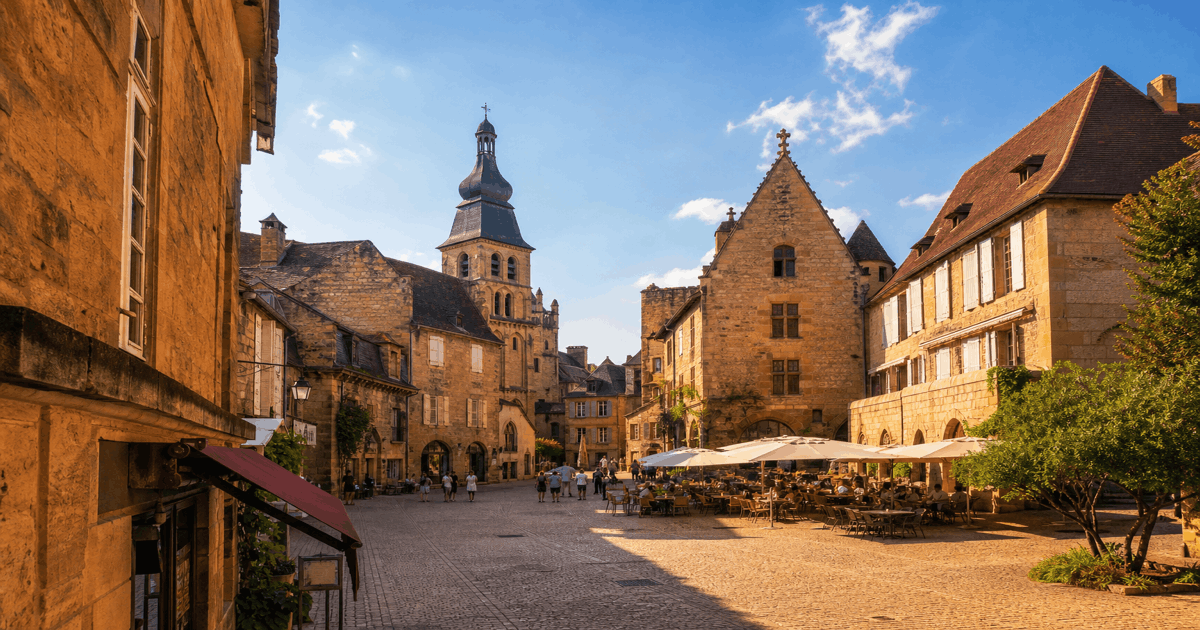
Sarlat-la-Canéda is a market town in the Dordogne where medieval and Renaissance buildings survive in unusual completeness. Wars of religion, economic decline, and later neglect accidentally preserved a town centre that richer cities rebuilt. Restoration in the 1960s under André Malraux revealed golden limestone facades, hidden towers, and covered markets. Today Sarlat is one of the best places in France to walk through layered urban history without a museum ticket.
Why Sarlat looks like this
Most French towns modernised aggressively in the 19th and 20th centuries. Sarlat could not afford to. When Malraux listed the centre as a protected sector, restorers stripped away later accretions to expose stone that had been hidden for generations. The result is a town where you read centuries of building in a single street view - Romanesque arches, Gothic towers, Renaissance doorways, and 19th-century market halls side by side.
Pilgrims bound for Santiago de Compostela passed through the Dordogne valley; Sarlat's inns and churches served that traffic for centuries. The town's relative independence - governed by its own consuls rather than a distant lord - explains why so many fine houses survive along Rue des Consuls.
Start at the tourist office in the former presbytery near the cathedral for maps and the restoration story.
Morning: cathedral hill and market square
Begin at Cathédrale Saint-Sacerdos, where Romanesque, Gothic, and later work combine in warm Sarlat stone. Beside it, the Lantern of the Dead is a rare cylindrical tower whose purpose historians still debate - funeral chapel, plague memorial, or beacon for pilgrims.
Open LocoPast nearby to explore the theories and the bishops buried in the adjacent cemetery. The Jardin des Enfeus collects medieval sarcophagi moved here for preservation - a quiet spot often missed by crowds.
Descend to Place de la Liberté on market day (Wednesdays and Saturdays). Medieval and Renaissance facades surround a space that has traded for centuries. Notable buildings include:
- Hôtel de la Boétie - birthplace of Étienne de la Boétie, philosopher and friend of Montaigne
- The former bishop's palace and town hall, facing each other across stalls of foie gras, walnuts, and truffles
- The covered market (Halle) behind the cathedral, continuing a tradition of fairs granted by royal charter
Afternoon: Rue des Consuls and hidden courtyards
Rue des Consuls was the street of power. Merchant-officials who governed Sarlat's considerable independence built here:
| Building | What to look for |
|---|---|
| Hôtel de Vassal | Tower, courtyard, mullioned windows |
| Hôtel de Mirandol | Spiral staircase turret visible from alleys |
| Hôtel de Carbonnier de Marzac | Sculpted doorways and heraldic stonework |
| Maison de La Filoli | 14th-century carved doorway and inner courtyard |
Rue Montaigne and parallel lanes form a grid of narrow passages between tall houses. Sudden views open to inner courtyards and stair turrets - medieval burgage plots extended upward as families grew richer.
The Manoir de Gisson opens its rooms and vaulted cellars to visitors: kitchens, bedrooms, and a courtroom where local justice was administered. One of the few interiors you can enter without appointment.
Église Sainte-Marie on Rue de la République now holds a lift to a bell-tower viewpoint - the panorama explains Sarlat's roofscape of slate, stone, and hidden gardens.
Day trip: prehistory at Lascaux
Twenty kilometres away, Montignac and the Lascaux caves place Sarlat in deep prehistory. Although the original cave is closed, the replica centre shows Palaeolithic art from the same landscape of cliffs and rivers. A morning in medieval Sarlat and an afternoon at Lascaux makes a satisfying contrast. In July and August, evening markets and torchlit walks add atmosphere without the midday heat.
Sarlat sits at the heart of Périgord Noir - châteaux, river valleys, and fortified villages lie within an hour's drive. Many visitors use the town as a base rather than a single-day stop.
On market days the Place de la Liberté fills with the smell of truffles and roast duck - tastes that connect directly to the forests and farms that funded the stone mansions around you.
Practical tips
Sarlat is compact but dense. Allow time to look up at turrets and down alleyways. Parking rings the old town; the core is pedestrian. Visit Sarlat Cathedral first, then wander without a fixed route - the pleasure is in discovery.
Wherever you walk, open LocoPast to reveal historical stories pinned to your exact location. Bishops, consuls, and truffle merchants all left marks on the map - often just courtyards away from the busy square.