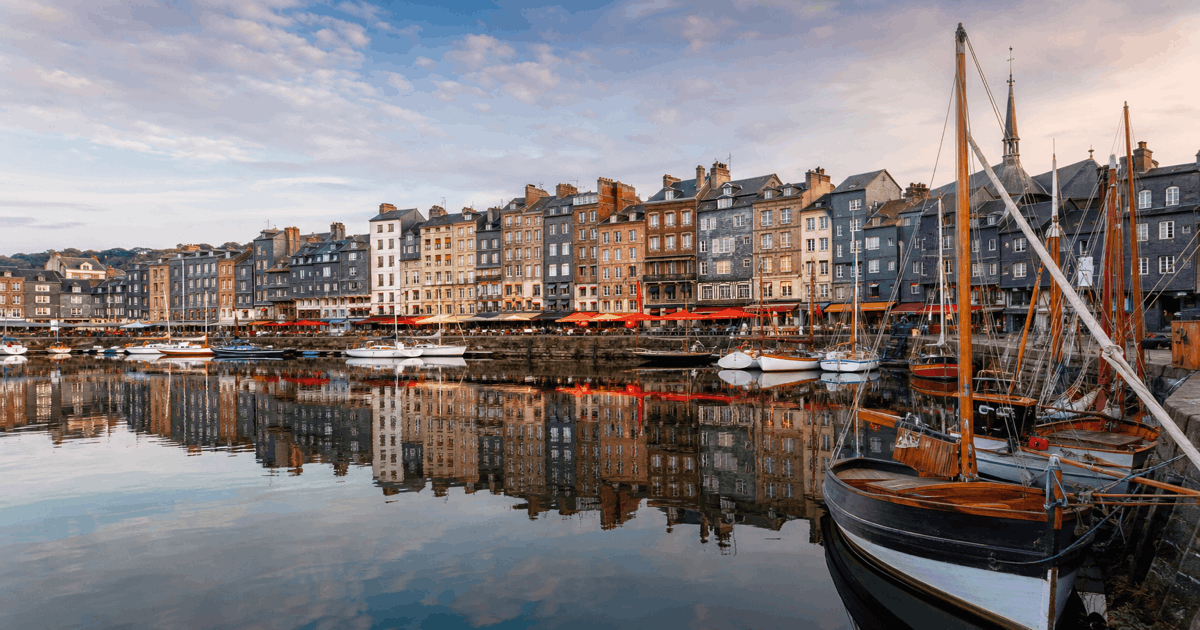
Honfleur sits at the mouth of the Seine estuary in Normandy, where medieval merchants traded with England and the New World. Its tall harbour houses inspired Impressionist painters; Samuel de Champlain sailed from here to found Quebec. Unlike larger Le Havre across the water, Honfleur preserved its old port almost intact. Two threads run through the town: maritime enterprise and artistic vision.
Maritime Honfleur: harbour, exploration, and salt
The Vieux Bassin and Lieutenance
The Vieux Bassin is Honfleur's heart: a rectangular basin ringed by narrow houses six storeys high. Built from the 17th century after the old port silted up, the quays replaced wooden structures with stone and timber that could withstand Atlantic weather. At the entrance, the Lieutenance is a medieval gatehouse that once controlled access to the fortress.
Open LocoPast on the quay to find stories of explorers, privateers, and Atlantic cod fleets tied to the waterfront.
Shipwrights' church and maritime museum
Église Sainte-Catherine is the largest wooden church in France, built by shipwrights after the Hundred Years' War. The separate bell tower across the square resembles a ship's mast - a precaution against fire, built with the same techniques as vessels on the nearby quays.
The Musée de la Marine, housed in the 19th-century church of Saint-Étienne, traces voyages to Canada and the tropics. Champlain's departure for Quebec in 1608 began a chapter that linked this small port to North America. Nearby Greniers à Sel - vaulted salt stores - held the salt for preserving cod on transatlantic voyages.
Sailors' chapel and estuary views
Notre-Dame de Grâce Chapel on the hill south of town overlooks the estuary. Ex-voto ships hang from the ceiling, offered by sailors grateful for safe return. The walk up through woodland passes stations of the cross and ends with one of the finest views in Normandy.
From Mont Joli across the estuary, artists and tourists still photograph the classic panorama of the Vieux Bassin, the Pont de Normandie, and Le Havre.
Artistic Honfleur: Boudin, Satie, and estuary light
Impressionism's birthplace
The Musée Eugène Boudin honours the Honfleur-born painter who taught Monet to work outdoors. Boudin's skies and harbour scenes sit alongside works by Courbet, Dubourg, and others drawn to estuary light. Boudin understood that Honfleur's weather and water were subjects in themselves.
The Jardin des Personnalités along the waterfront path features busts of Boudin, Satie, Baudelaire, and others - mapping the cultural network that grew around the port.
Satie and the upper town
Erik Satie was born in Honfleur in 1866. Plaques and the surreal "Maison des Musiques" experience connect the town to 20th-century avant-garde music, far from the Impressionist harbour scenes.
Rue des Capucins and neighbouring lanes hold timber-framed and stone houses from the 15th to 18th centuries - the residential counterpart to the harbour's commercial frontage. Saint-Léonard Church anchors the upper town where dock workers lived.
Near the beach, the promenade and Naturospace butterfly house reflect Honfleur's 19th-century expansion as a seaside resort, when Parisians arrived by steamer for salt air. The town's scale - small enough to walk end to end - makes it easy to link maritime and artistic sites in one day.
Coast path and practical tips
Walking the Côte de Grâce towards Trouville and Deauville passes villas, bunkers from the Atlantic Wall, and wide estuary views. Honfleur's history is inseparable from this water: tides that silenced the old port, light that drew painters, and channels that carried explorers west.
Honfleur Harbour is compact; park outside the old centre in busy seasons. Start with the Vieux Bassin and Sainte-Catherine, then choose maritime or artistic sites for the afternoon. Mont Joli or Notre-Dame de Grâce rewards those with a car or stout legs.
Honfleur pairs naturally with Deauville and Trouville across the estuary for a longer Normandy coast day - but the old harbour rewards an unhurried morning when the light is still soft on the tall facades and the quays are quiet.
The Greniers à Sel near the Vieux Bassin show the scale of the cod trade - vaulted halls that held tonnes of salt for preserving fish bound for Paris and beyond. Exhibitions now fill the space, but the architecture still speaks of Honfleur's commercial ambition.
Wherever you stop, open LocoPast to reveal historical stories pinned to your exact location. Shipwright churches, cod fleets, and Impressionist easels all left marks on the map - often just quays away from the famous reflections.
Satie's Maison des Musiques offers an immersive experience of the composer's odd humour - a 20th-century footnote that surprises visitors who come only for Boudin's skies and harbour reflections.