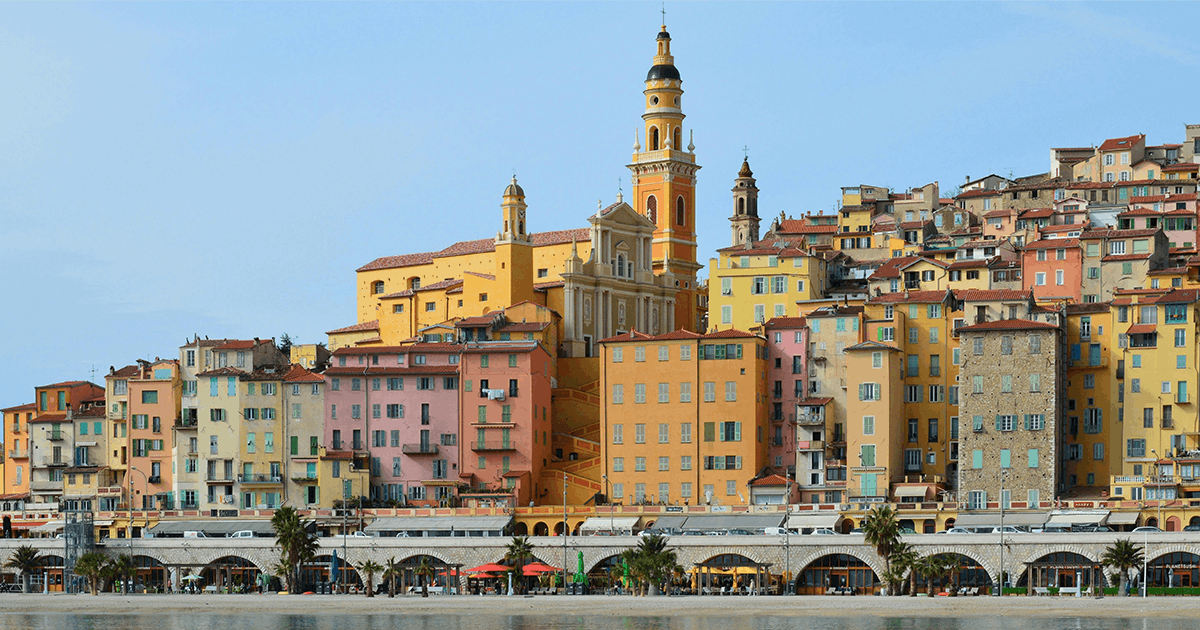
Menton sits at the eastern edge of France, where the Alps meet the Mediterranean and Italian influence is never far away. Lemons, baroque architecture, and a mild climate drew aristocrats and artists; Jean Cocteau left murals and museums that still define the town. This guide follows a natural walking route from the sea to the hills - climb as the town itself grew.
Sea level: port, Cocteau, and the market
Start on the waterfront. The Musée Jean Cocteau, Bastion occupies a 17th-century fortified tower open to the sea. Drawings, ceramics, and tapestries show the range of Cocteau's work; the building itself is part of the experience.
Nearby, the Marché des Halles on Quai de Monléon sells local produce under a 19th-century iron structure. The lemon holds place of honour - Menton's symbol for centuries. The Promenade du Soleil runs towards the Italian border, laid out when Menton joined the fashion for winter health resorts.
The Casino Barrière (1920s) recalls interwar glamour, when Menton competed with Monte Carlo for wealthy visitors.
Climbing the Vieille Ville
From the port, enter the Vieille Ville - terraces of narrow lanes, painted façades, and vaulted passageways climbing towards the basilica. Unlike larger Riviera resorts, Menton still feels like a provincial town where locals and visitors share the same squares.
Pause at Porte Saint-Julien, a fragment of medieval gate on the edge of the old town - one of few visible reminders of walls that once encircled Menton when the Italian border meant fortifications and tolls.
Near the summit, the Chapelle des Pénitents Blancs belongs to a confraternity that still maintains the building. Baroque interior, modest exterior - typical of Provence's community chapels.
The basilica and cemetery hill
Basilique Saint-Michel-Archange dominates the skyline with soaring baroque façade and golden stucco. Built in the 17th century on an earlier church site, it anchors the old town above a long flight of steps. Open LocoPast on the steps to find stories of border politics and Counter-Reformation patronage.
Above the town, the Cimetière du Vieux-Château holds tombs of Menton's notable families with views across the bay to Italy. Cocteau is buried nearby at the Chapelle Saint-Pierre - a pilgrimage site for admirers of his work.
Cocteau, Russians, and gardens
Descend via separate routes to pick up sites beyond the old town:
- Salle des Mariages murals in the Hôtel de Ville - Cocteau painted the wedding room; couples still marry beneath these walls
- Musée Jean Cocteau, collection Severin Wunderman near the market - complements the Bastion museum
- Église Orthodoxe Russe Saint-Nicolas - onion domes built for the Russian community that wintered here before the First World War
- Palais Carnolès - former Grimaldi residence with one of France's finest citrus collections in the gardens; visit in spring when orange and lemon blossoms are in flower
- Val-Rahmeh and Serre de la Madone on the hills above - historic gardens benefiting from Menton's microclimate; Lawrence Johnston laid out Serre de la Madone in the 1920s with terraced paths and rare species
Menton's Lemon Festival (February) is a modern celebration of a crop grown here since the Middle Ages. The mild microclimate - protected by mountains from northern winds - made Menton a winter refuge long before Cocteau arrived.
The town sits on the Grimaldi sphere of influence - Monaco is minutes away by train - but Menton kept a distinct character when it joined France in 1860. Italian cafés, pastel facades, and the basilica's golden stucco still feel closer to Liguria than to Provence.
Walk the Corso Italia towards the border for a sense of how close Italy remains - Menton's history is inseparable from that frontier, even when the customs posts are gone.
Practical tips
Menton is compact; most central sites are within walking distance. Climb to the basilica in the morning before heat builds. Gardens at Carnolès and Serre de la Madone need extra time. Visit Basilique Saint-Michel when the light catches the golden stucco.
The Jean Cocteau trail links Bastion museum, town hall murals, and Wunderman collection - allow a full day if Cocteau matters to you, or pick one site and combine it with the basilica climb.
Cimetière du Vieux-Château offers some of the best views in Menton - tombs and mausoleums of local families with Italy visible across the bay on clear days.
Wherever you stop, open LocoPast to reveal historical stories pinned to your exact location. Border fortresses, baroque patrons, and artistic exiles all left marks on the map - often just streets away from the famous viewpoints.