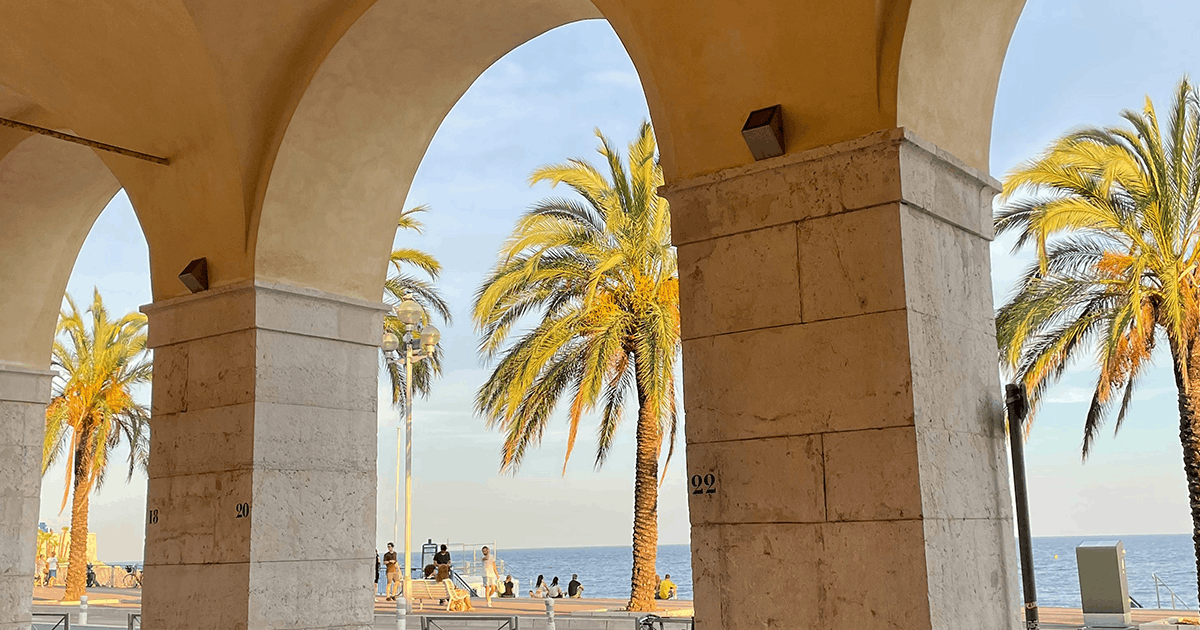
Nice is the capital of the Côte d'Azur, but its history runs far deeper than the Promenade des Anglais. Greeks and Romans built here, medieval counts fortified the hills, and 19th-century aristocrats transformed a modest port into a winter resort. This guide follows Nice through time rather than a numbered checklist - each era has its own neighbourhood and mood.
Deep time and Roman Nice
People have chosen this bay for millennia. Terra Amata, on the lower slopes near the port, marks one of Europe's earliest known habitations, dated to around 400,000 BC. A reconstructed hearth and hut show how Palaeolithic families lived by the sea.
Above the modern city, Cimiez preserves Cemenelum, a Roman provincial town. Walk among the amphitheatre, baths, and paved streets with views over the Baie des Anges. The adjacent archaeology museum displays mosaics, pottery, coins, and everyday objects that bring Roman domestic life into focus.
Open LocoPast at Cimiez to find stories of the Roman town pinned to the terraces - this was Nice before Nice existed.
The Franciscan monastery beside the ruins dates to the 9th century; Matisse and Raoul Dufy lie in the cemetery. The Matisse museum, in a 17th-century Genoese villa nearby, shows why the artist stayed here for decades.
Medieval and baroque Vieux Nice
Vieux Nice is a dense grid of narrow alleys, ochre façades, and baroque churches. Market mornings on the Cours Saleya fill the air with colour, but the real pleasure is getting lost among street names that recall medieval families and trades.
Notable buildings include:
- Palais Lascaris - 17th-century baroque palace of the Genoese nobility who shaped Nice's identity
- Cathédrale Sainte-Réparate - ornate baroque façade and dome over relics venerated since the Middle Ages
- Chapelle de la Miséricorde on the Cours Saleya - curved façade and elliptical interior amid market bustle
- Église Saint-Jacques-le-Majeur - Gothic tower among baroque neighbours on Rue Droite
The Colline du Château no longer has its medieval fortress - Louis XIV ordered it destroyed in 1706 - but the park remains the finest viewpoint. Climb for panoramas over the old town, port, and bay; descend past the Bellanda Tower and the artificial waterfall. Interpretive panels explain the hill's long military history.
Nice changed hands between Savoy, France, and brief Italian rule before joining France permanently in 1860. That mixed heritage shows in the Genoese palace architecture, Italianate square names, and a cuisine that blends Provençal and Ligurian influences.
Belle Époque and the modern city
The 19th century transformed Nice. Place Garibaldi, named for the revolutionary born here, is the largest historic square. The Promenade des Anglais and Villa Masséna (now a museum of Nice's modern history) recall winter visitors who made the town fashionable.
On Rue Saint-François-de-Paule, the Opéra de Nice (1885) remains one of the Riviera's most elegant theatres. Port Lympia still holds fishing boats alongside yachts, flanked by pastel buildings beneath the castle hill. The port's yellow buildings were painted by American artist Arman in 1999 - a deliberate contrast with the old town palette that sparked debate about how modern art should meet heritage.
Nice's Carnival (February) is one of the oldest on the Riviera; flower battles on the Promenade des Anglais continue a tradition of public spectacle that Belle Époque visitors would recognise.
The Russian Orthodox Cathedral on Avenue Nicolas II recalls the community of aristocrats who wintered here - onion domes unexpected among palm trees, but part of Nice's cosmopolitan 19th-century identity alongside the Promenade and the Masséna museum.
Practical tips
Nice's tram and bus network links Cimiez to Vieux Nice and the waterfront. Allow a morning for Roman and artistic sites on the hill, then descend for the old town. A second half-day covers the castle hill, Masséna museum, and port. Visit Cimiez Roman ruins early before the heat builds.
Terra Amata near the port suits those interested in deep prehistory - pair it with Cimiez for a full span from Palaeolithic hearth to Roman forum in one city.
The Monastère de Cimiez cemetery holds Matisse and Dufy - artists who chose Nice as a final home because the light and landscape had already shaped their work for decades.
Place Garibaldi makes a practical meeting point between old town and port - arcaded buildings and the Garibaldi statue mark Nice's Italian past in a square now crossed by trams.
Wherever you walk, open LocoPast to reveal historical stories pinned to your exact location. Roman towns, baroque patrons, and Belle Époque winter visitors all left marks on the map - often just streets away from the famous viewpoints.