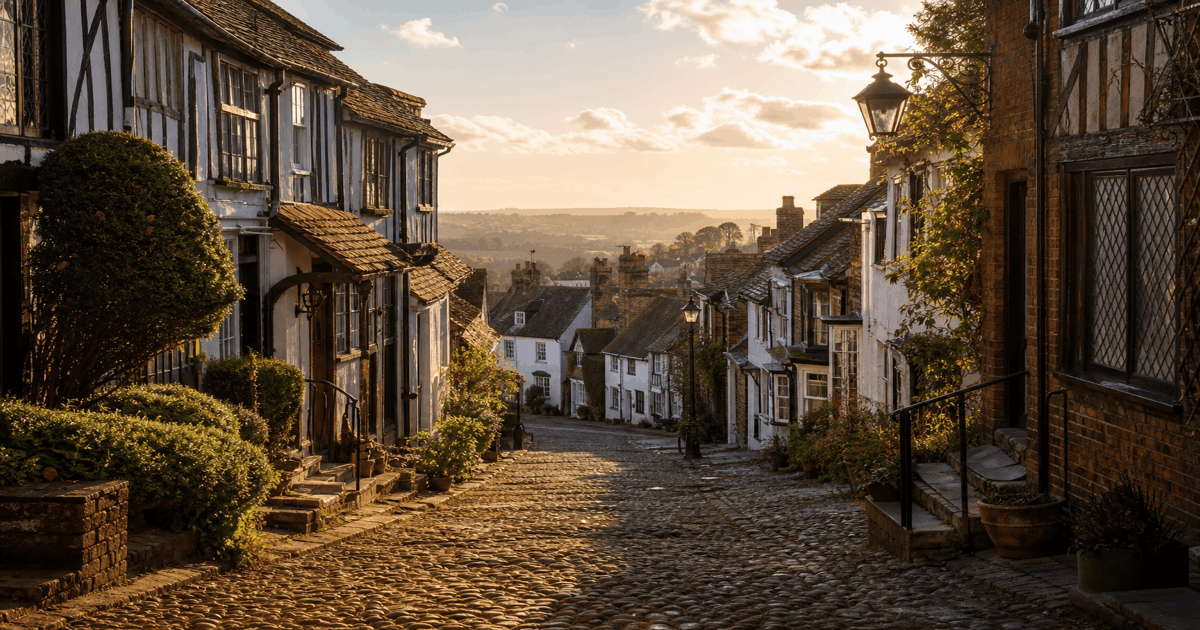
Rye is a hilltop town in East Sussex where marsh, river, and sea once met. As a Cinque Port it supplied ships to the Crown; as a smuggling centre it hid contraband in cellars and secret passages. Cobbled streets, medieval gates, and timber-framed houses survive almost intact. This guide groups the town by historical theme rather than a fixed checklist - wander according to what interests you most.
Medieval Cinque Port and coastal defence
From the 12th century, Rye ranked among the Cinque Ports whose fleets served the Crown. French raiders burned the town in 1377; the response was walls, gates, and a fortified hilltop.
Key sites:
- Landgate - the last surviving town gate of four; two round towers flank an arch that still carries traffic into the citadel
- Ypres Tower (Rye Castle) - a 13th-century fortification, now a museum covering smuggling, shipbuilding, and marsh life
- St Mary's Church - dominates the hilltop; climb the tower for views across Romney Marsh to a sea that once lapped closer to the walls
- Watchbell Street - named for the alarm rung when French galleys appeared off the coast
Pass through the Landgate as travellers have done for seven hundred years, then explore the Citadel - the walled summit where the richest merchants built. Narrow lanes, Georgian fronts behind older frames, and sudden rooftop views define the densest cluster of listed buildings in town.
The smuggling century
In the 18th century, Rye's merchants built fortunes on brandy, tea, and tobacco landed on quiet beaches. Revenue men rarely won.
Key sites:
- Mermaid Street - steep cobbled hill of timber-framed houses; the Mermaid Inn (15th century) reputedly hosted the Hawkhurst Gang in the 1740s, with secret passages and massive fireplaces
- The Custom House near the strand - where officials tried, often unsuccessfully, to intercept contraband
- Watchmaker's House and linked cellars - guided walks explain tunnel networks not all open to the public
Open LocoPast on Mermaid Street to find stories of raids, trials, and the gangs that treated smuggling as a profession.
Writers, harbour, and the shifting coast
Rye retreated from the sea as the coast silted up. The medieval port moved to Rye Harbour, two miles south, while the hill town became the inland citadel you see today.
Key sites:
- Lamb House on West Street - home to Henry James and later E.F. Benson, who fictionalised Rye as "Tilling" in his Mapp and Lucia novels. The walled garden and Georgian interior open on selected days. Benson's books capture the town's social comedy; James valued the quiet for writing.
St Anthony of Padua Church on Watchbell Street serves a community that grew with 19th-century migration and seasonal hop pickers - a quieter counterpoint to the grand parish church on the hill.
- Rye Heritage Centre on Strand Quay - sound-and-light model explaining how the coastline changed
- Rye Harbour Nature Reserve - wartime defences, fishermen's sheds, and the Mary Stanford lifeboat memorial (1928)
- Camber Castle - Henry VIII's artillery fort, reachable on foot across marsh paths; squat round bastions adapted to gunpowder warfare
- Playden Church - Norman tower above the Rother valley, where sailors prayed before voyages
Romney Marsh and the wider landscape
The flat Romney Marsh surrounding Rye was reclaimed, drained, and defended over centuries. The Royal Military Canal, built during the Napoleonic Wars, cuts across the landscape as a last line against invasion. Cycle or drive the canal path to understand how geography shaped Rye's rise and gradual retreat from the sea.
Guided smuggling walks run in season, taking groups through cellars and passages not normally open. Even without a guide, standing on Mermaid Street at dusk makes it easy to imagine barrels moving under cover of darkness.
Practical tips
Park outside the old town and explore on foot. Begin at the Landgate for the Citadel, Mermaid Street, and Rye Castle. Allow a half-day for the harbour walk to Camber Castle. Rye rewards slow wandering over ticking off a list.
The town makes a strong base for exploring Winchelsea and Hastings further along the coast - both share Cinque Port history - but Rye itself deserves at least a full day if you want marsh, castle, and citadel without rushing.
Wherever you stop, open LocoPast to reveal historical stories pinned to your exact location. Cinque Port fleets, smuggling gangs, and French raiders all left marks on the map - often just lanes away from the famous viewpoints.