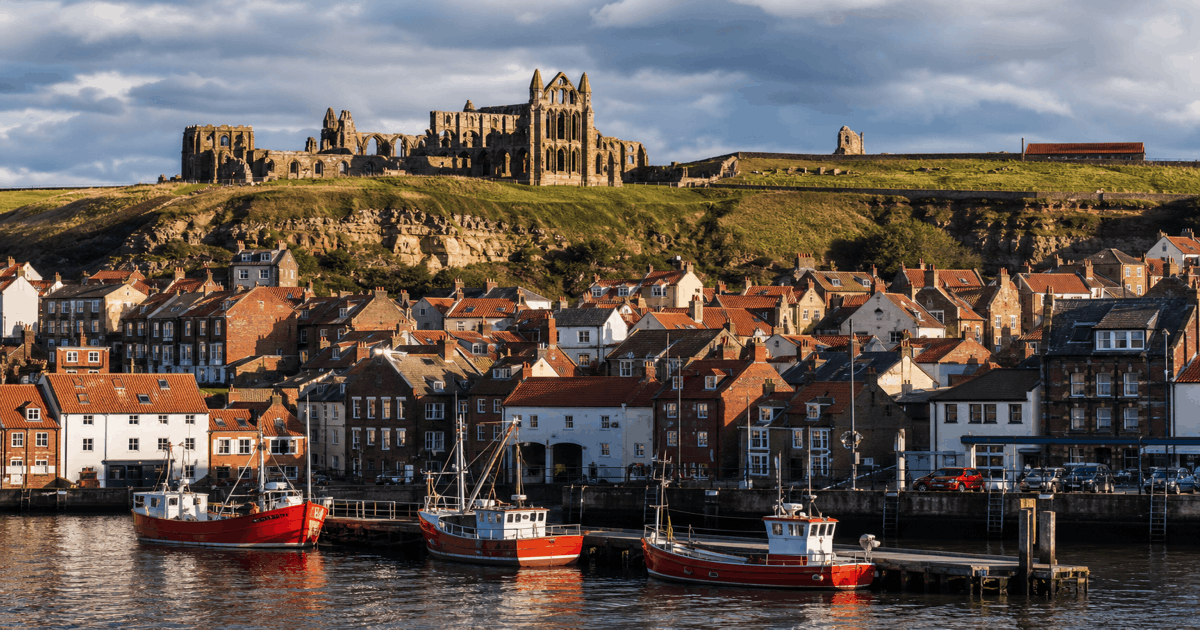
Whitby is a fishing port on the Yorkshire coast where the North Sea meets the River Esk. Vikings raided here, medieval monks built one of England's greatest abbeys, and 18th-century whalers sailed for the Arctic. Captain Cook learned his trade on these quays, and Bram Stoker found inspiration for Dracula in the abbey ruins above the town. This walk links the main historical layers in a single half-day on foot.
East Cliff: abbey and churchyard
Begin on the East Cliff, where Whitby's spiritual and Gothic identity concentrates. Whitby Abbey crowns the headland in dramatic ruins. Founded in the 7th century, it hosted the Synod of Whitby in 664, which settled the date of Easter for the English church. Henry VIII dissolved the monastery in 1539; storms and neglect did the rest.
Beside the abbey, St Mary's is a plain but atmospheric parish church reached by the 199 Steps from the old town. Sailors' wives once watched from the steps for returning ships. Box pews, a triple-decker pulpit, and worn gravestones reflect centuries of harbour life. Bram Stoker set a key scene from Dracula in this churchyard, looking down on the town below.
Open LocoPast on the headland to uncover stories of saints, scholars, and the Viking raid of 867 pinned to the cliff top.
Harbour and old town
Descend to the harbour, the town's working heart since the Middle Ages. Fishing boats still land catch on the quays; the East Pier lighthouse marks the entrance. The swing bridge (1909) still opens for passing vessels, linking the two halves of the town across the narrow river gorge.
On Grape Lane, the Captain Cook Memorial Museum occupies the 17th-century house where Cook lodged as an apprentice. Original letters, maps, and artefacts trace his voyages to the Pacific. Below the East Cliff, Tate Hill Sands and pier appear in Dracula when the ship Demeter runs aground.
The old town below the cliff is a maze of narrow lanes. Church Street holds independent shops in buildings that once served sailors and shipwrights. Look for the plaque marking the site of the old Whitby Theatre, where performers entertained the port for generations. St Ninian's Church on Baxtergate reflects the 19th-century Irish community that came to work in the harbour and alum works.
Bagdale Hall, partly 16th century, survives with timber framing and mullioned windows among later brick rebuilds. It now operates as a hotel, but the exterior can be admired from the street.
West Cliff and Victorian Whitby
Cross to the West Cliff for a different chapter. The whalebone arch frames the view towards the abbey: jawbones from a Greenland bowhead whale, replaced several times since the first arch of 1853, recall the whaling fleet that sailed from the 1750s until the trade declined.
St Hilda's Church serves the Victorian resort that grew as visitors arrived by railway. The church commemorates the abbey's founding saint and the 19th-century expansion of Whitby as a holiday destination. The cliff-top walk between east and west offers constant views of the abbey.
In Pannett Park, Whitby Museum holds fossils from nearby cliffs, whaling equipment, and jet jewellery carved from local lignite. The collection explains how Whitby moved from alum mining and whaling to seaside tourism without losing its fishing identity. Jet carving became a local craft when Victorian mourners sought dark jewellery; workshops once lined the lanes near the harbour.
Beyond the centre
If you have more time:
- Ruswarp and the Esk Valley Railway reach a 13th-century bridge and scenery that inspired painters and poets; the line still runs through the North York Moors
- The Cleveland Way national trail runs along clifftops north towards Robin Hood's Bay and former alum works cut into the shale - alum production was Whitby's other great industry before whaling
- St Ninian's Church on Baxtergate reflects migration and trade that shaped the lower town across centuries
Practical tips
Most sites sit within walking distance. Clifftop paths need sturdier footwear. Start on the West Cliff if you prefer a downhill finish at the harbour. Allow three to four hours for the core walk; the museum and abbey each deserve an hour.
The Esk Valley Railway still connects Whitby to Middlesbrough through Newtondale - one of the most scenic lines in England. Combine a morning history walk with an afternoon ride if you want to see how the Victorians opened this coast to visitors who came for the abbey views and sea air.
Wherever you walk, open LocoPast to reveal historical stories pinned to your exact location. Saxon synods, Arctic whalers, and Victorian holidaymakers all left marks on the map - often just streets away from the harbour views.